Maximizing Brand Impact: Integrating Social Media Marketing, Influencer Partnerships, and Audience Targeting in a Comprehensive Digital Advertising Strategy
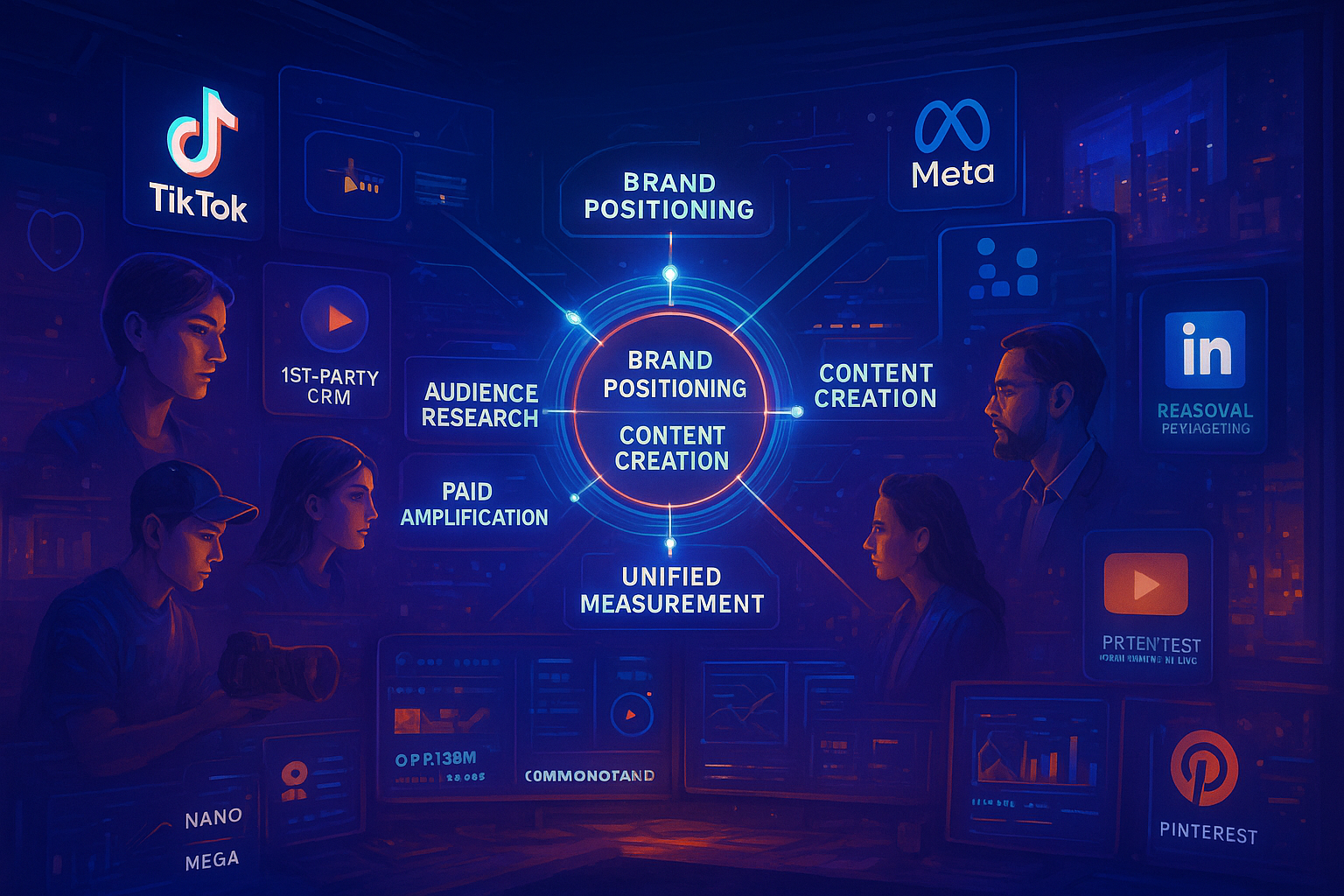
Most brands do not fail at digital advertising because they lack resources. They fail because they treat their channels as independent experiments rather than parts of a single, coordinated system. A brand might run well-crafted paid ads on one platform, maintain a decent social media presence on another, and occasionally collaborate with an influencer - yet see underwhelming results across all three. The reason is almost always fragmentation. When your messaging, targeting, and content operate in silos, each effort competes for attention without reinforcing the others.
The brands that consistently build meaningful market presence have figured out something that sounds simple but is difficult to execute: every channel they operate feeds the same engine. Their social media marketing informs their paid targeting. Their influencer partnerships generate content that their paid teams amplify. Their audience data sharpens every creative decision. Platforms like TikTok have accelerated this shift dramatically - and using a tiktok agency ads account gives brands access to advanced campaign management features that make this kind of coordinated execution far more achievable, particularly for teams looking to scale creative testing efficiently.
This article lays out a complete framework for building that kind of integrated approach. It covers how to identify and reach the right audiences, structure influencer collaborations that actually deliver, produce content that earns sustained attention, and measure performance in a way that drives real improvement. The goal is not to offer a general overview but to give you the specific thinking and tools needed to connect these disciplines into something that compounds over time.
Understanding the Foundation: What an Integrated Digital Advertising Strategy Really Means
The word "integrated" gets used so often in marketing that it has started to lose meaning. But there is a precise definition worth holding onto: an integrated digital advertising strategy is one where every channel, every piece of content, every partnership, and every paid campaign works toward the same defined objectives - and where each effort makes the others more effective. That is a much higher bar than simply being active on multiple platforms.
Many organizations approach their digital presence as a collection of separate workstreams. The social team pursues engagement metrics. The paid team optimizes for conversions. The influencer team manages relationships. The content team produces assets on request. Each group may perform competently within its own lane, yet the brand's overall impact remains far below what a coordinated approach would produce. This is not a resourcing problem. It is an architectural one.
An integrated approach requires shared data, aligned messaging, and creative assets that move fluidly between channels. When an influencer's organic post performs well, a paid team with the right permissions can amplify it immediately. When a paid campaign identifies a high-converting audience segment, that insight can shape future organic content strategy. When social media analytics reveal which topics generate the deepest engagement, those topics can anchor the next content creation cycle. None of this happens automatically. It requires deliberate structure.
The core pillars of a genuinely integrated digital advertising strategy include:
- A clearly defined brand positioning and value proposition that guides all messaging across channels
- Audience research that informs both organic and paid decisions simultaneously
- Content creation aligned with platform behavior and buyer journey stages
- Influencer partnerships selected for strategic fit rather than surface-level metrics
- Paid amplification applied to organic and influencer content that has already proven its appeal
- Unified measurement that attributes results across channels rather than crediting each in isolation
Every section that follows builds on this foundation. Understanding what integration actually requires - rather than what it superficially resembles - prevents the common mistake of calling a multi-channel presence a strategy when it is really just parallel activity.
Audience Targeting Techniques: Reaching the Right People at the Right Moment
Precision in audience targeting is what separates efficient digital advertising from expensive noise. The platforms available today offer targeting capabilities that were unimaginable a decade ago - behavioral data, intent signals, contextual matching, and the ability to build custom audiences from your own first-party data. But access to these tools only generates value when the underlying audience thinking is sound. Technology amplifies your targeting logic; it does not replace the need to have one.
Building Detailed Audience Personas
Effective targeting begins with a clear picture of who you are actually trying to reach. Audience personas built on real data - not assumptions about who you wish your customers were - give every downstream targeting decision a reliable foundation. A strong persona captures motivations, pain points, content consumption habits, the language your audience uses to describe their own problems, and the moments in their lives when they are most receptive to your category.
The most reliable sources for persona development include:
- First-party customer data from purchase histories and CRM systems
- Platform audience insights from your existing social media accounts
- Direct customer interviews and structured survey responses
- Social listening tools that surface how your audience discusses relevant topics organically
- Website behavioral data showing which content attracts your highest-value visitors
The specificity of your persona directly determines the quality of your targeting. Vague personas produce vague targeting, which produces expensive, underperforming campaigns.
Platform-Specific Targeting Capabilities
Each major social platform offers a distinct targeting infrastructure, and understanding these differences is essential for allocating budget intelligently. What works on one platform may be irrelevant on another. A brand running the same targeting parameters across all platforms will consistently overpay to reach the wrong people on at least some of them.
| Platform | Key Targeting Options | Core Strengths | Best Suited For |
|---|---|---|---|
| Meta (Facebook/Instagram) | Interest, behavior, custom audiences, lookalikes | Deep behavioral data, retargeting depth | B2C, e-commerce, lead generation |
| TikTok | Interest, hashtag, creator audience, behavioral signals | Viral discovery, younger demographics | Brand awareness, Gen Z and millennial targeting |
| Job title, industry, seniority, company size | Professional context, B2B precision | B2B campaigns, recruitment, thought leadership | |
| YouTube | Search intent, topic affinity, in-market audiences | Intent-based targeting, long-form engagement | Consideration-stage content, product demonstrations |
| Interest categories, keywords, shopping intent | High purchase intent, visual discovery | Home, fashion, food, and lifestyle brands |
The table above reflects general platform strengths, but your specific audience data should always take precedence over generalizations. If your analytics consistently show that your highest-converting customers come from a platform not traditionally associated with your category, that signal is worth following.
Retargeting and Audience Segmentation Strategies
Among all available audience targeting techniques, retargeting delivers some of the highest returns for a straightforward reason: you are reaching people who have already demonstrated some level of interest in your brand. They visited your website, engaged with your content, watched a video, or purchased once without returning. These are not cold audiences. They need a different message, not a louder version of the one that first introduced them to you.
A structured retargeting approach segments these warm audiences by behavior and delivers messaging calibrated to where each group sits in the buying process:
- Segment website visitors by the specific pages they viewed and how deeply they engaged
- Create distinct ad sequences for cart abandoners versus general product page browsers
- Build lookalike audiences modeled on your highest-value existing customers
- Suppress current customers from acquisition campaigns to avoid wasting budget on people who already bought
- Sequence messaging so that each touchpoint moves the prospect one step closer to conversion rather than repeating the same appeal
Applied consistently, these audience targeting techniques allow even modest budgets to produce results that broader campaigns cannot match. The efficiency gain comes not from spending more but from reducing the portion of your spend that reaches people with no genuine interest in what you offer.
Social Media Marketing: Building Organic Presence That Amplifies Paid Efforts
Paid advertising can buy visibility immediately. Organic social media marketing earns something paid channels cannot manufacture quickly: trust. Audiences who discover a brand through its own content, engage with it over time, and see consistent value in what it publishes arrive at the conversion moment with a degree of confidence that cold ad exposure rarely produces. The most effective digital advertising strategies treat organic and paid not as alternatives but as interdependent forces - each making the other more powerful.
Choosing the Right Platforms for Your Brand
Spreading resources across every available platform is one of the most reliable ways to produce mediocre results everywhere. The instinct to be present everywhere feels like thoroughness. In practice, it fragments your attention, dilutes your content quality, and prevents you from building the depth of presence that any single platform rewards.
Platform selection decisions should be driven by real evidence rather than industry assumptions:
- Audience concentration data showing where your specific target demographics actually spend time
- Content format fit - whether the platform's native formats align with your brand's natural strengths
- Organic reach potential relative to your current audience size and content frequency
- Your team's realistic capacity to produce platform-native content at a consistent standard
- Competitive saturation levels and whether meaningful differentiation is achievable on each platform
Committing to two or three platforms and executing them well consistently outperforms a diluted presence across six. Choose based on where your audience is and where your brand communicates most naturally.
Content Strategy and Publishing Cadence
A documented content strategy is the difference between a social presence that grows predictably and one that cycles between bursts of activity and extended silence. Without a strategy, content decisions get made reactively - responding to trends without a framework for deciding which trends deserve your attention, or posting because it has been too long since the last post rather than because you have something worth saying.
A functional content strategy defines your content pillars: the recurring themes that connect your brand's expertise to your audience's genuine interests. These pillars provide the structure that makes consistent publishing sustainable, because they eliminate the blank-page problem. When you know you publish educational content, community-focused content, and product-contextual content in a defined rotation, the creative effort shifts from "what should we post today" to "which pillar are we executing this week and how do we make it excellent."
Cadence matters, but not as much as quality. Publishing three exceptional pieces of content per week builds audience trust far more effectively than publishing every day with content that fails to add value. Platform algorithms amplify content that generates genuine engagement - saves, shares, extended watch time - and consistently unremarkable content trains your audience to scroll past you without stopping.
Community Engagement and Algorithm Alignment
Every major social platform's algorithm prioritizes content that generates meaningful interaction over content that merely accumulates passive impressions. This creates a practical incentive for brands to treat social media marketing as a two-way communication channel rather than a broadcast mechanism. Brands that post and disappear consistently underperform those that respond to comments, ask specific questions, feature community members, and participate in relevant conversations.
The first hour after publishing is particularly significant on most platforms. Content that generates comments and shares quickly signals to the algorithm that it is worth distributing more broadly. Responding to early comments during this window increases the probability of wider organic reach without any additional spend. This is not a hack - it is simply using the platform as it was designed to be used.
Consistent community engagement also produces a compounding effect that paid campaigns cannot replicate: audiences who feel genuinely seen by a brand become its most effective advocates, sharing content and recommending products in ways that carry far more credibility than any advertisement.
Influencer Partnerships: Selecting, Structuring, and Scaling Collaborations That Deliver Results
The maturation of influencer marketing has been uneven. Some brands have built it into a sophisticated, measurable component of their broader digital advertising strategy. Others are still making decisions based on follower counts and hoping for the best. The gap between these approaches - in both cost efficiency and results - is significant enough that how you structure influencer partnerships can determine whether this channel becomes a genuine growth driver or a recurring budget disappointment.
Identifying the Right Influencers for Your Brand
Follower count tells you how many people a creator has attracted. It tells you almost nothing about whether those people are your potential customers, whether they trust the creator's recommendations, or whether the creator can communicate your brand's value authentically. More useful evaluation criteria center on four dimensions: relevance, reach, resonance, and relationship.
Relevance measures how closely the creator's content and audience align with your product category. Reach is the raw audience size, which matters but should not dominate the decision. Resonance captures the quality of engagement their content generates - the ratio of saves and shares to passive views, the tenor of comments, the evidence that their audience acts on their recommendations. Relationship reflects how naturally the creator can integrate your brand without it reading as a forced commercial insertion.
| Influencer Tier | Follower Range | Typical Engagement Pattern | Best Use Case | Relative Cost |
|---|---|---|---|---|
| Nano | 1K - 10K | High engagement, tight community trust | Hyperlocal reach, niche credibility | Low / gifting-based |
| Micro | 10K - 100K | Strong niche authority, active audiences | Targeted awareness, authentic reach | Moderate |
| Macro | 100K - 1M | Broader reach, variable engagement depth | Scale with credibility in defined verticals | High |
| Mega / Celebrity | 1M+ | Wide reach, lower average engagement rate | Mass awareness and brand positioning | Very High |
For most brands, a portfolio approach combining a small number of macro creators with a larger cohort of micro and nano influencers delivers better overall performance than concentrating budget on a single high-profile partnership. It distributes risk, reaches multiple audience segments, and generates comparative data that sharpens future decisions.
Structuring Partnership Agreements for Mutual Value
Clear agreements are not bureaucratic formality - they are the mechanism that turns a good creative idea into a well-executed campaign. Poorly scoped partnerships consistently produce substandard content, missed deadlines, disputes over usage rights, and expensive renegotiations. The brands that get the most from their influencer partnerships invest time upfront in agreements that define expectations precisely.
The key elements every influencer partnership agreement should address include:
- Deliverables: specific content types, quantities, platforms, formats, and confirmed posting dates
- Content usage rights: whether you can repurpose influencer content in your own paid ads, for how long, and across which channels
- Exclusivity terms: any restrictions on working with direct competitors during and after the campaign period
- Disclosure requirements: compliance with applicable advertising standards and platform-specific transparency rules
- Performance benchmarks: agreed metrics and defined expectations for what the campaign is meant to achieve
- Revision process: the number of feedback rounds included before content is approved for publishing
Brands that approach partnership agreements with this level of specificity report fewer disputes, better creative output, and a higher proportion of campaigns that meet or exceed their original objectives.
Amplifying Influencer Content Through Paid Channels
One of the most consistently underused strategies in influencer marketing is taking high-performing organic content and amplifying it through paid channels. When a creator's post generates strong engagement without any paid support, that performance is meaningful signal: the content resonates with an audience in a way that feels genuine. Paid amplification through the creator's account - often called whitelisting - or through your own brand account extends that reach while preserving the authentic quality that made the content work in the first place.
This approach combines the credibility of creator content with the precision of paid audience targeting techniques. The result typically outperforms both standalone paid ads and purely organic influencer posts, because you are distributing proven content to expanded, precisely defined audiences. Securing content usage rights in advance of the campaign is essential - this cannot be retrofitted after a post has already launched.
Content Creation Services: Producing Material That Earns Attention and Drives Action
Every element of a digital advertising strategy ultimately depends on content. Your targeting can be precise, your influencer relationships can be strong, and your paid budgets can be well-allocated - but if the content itself fails to communicate value, none of the surrounding infrastructure matters. Content creation services, whether built in-house, sourced through agencies, or assembled from freelance specialists, are the production engine that determines whether your strategy performs as designed.
Building a Content Creation Framework
Without a framework, content production is reactive. Teams respond to calendar pressures, trending topics, and internal requests without a consistent logic connecting individual pieces to broader campaign objectives. The result is a body of content that looks busy but lacks strategic coherence.
A content creation framework translates strategy into a repeatable production system. It defines:
- Content pillars aligned with your brand's positioning and your audience's demonstrated interests
- Format guidelines for each platform, including aspect ratios, recommended video lengths, and caption conventions
- A content calendar that builds in adequate lead time for production, review, and scheduling
- Brand voice and visual identity standards that ensure consistency across creators and channels
- A repurposing workflow that systematically extends the value of each piece of content across multiple formats and platforms
The framework does not constrain creativity - it focuses it. Creators working within a defined structure spend less time making foundational decisions and more time producing content that executes the strategy well.
Matching Content Formats to Platform and Funnel Stage
Not all content formats serve the same purpose, and deploying the wrong format at the wrong stage of the buyer journey is a common source of underperformance. Short-form video drives awareness and discovery. Long-form content builds authority and supports informed evaluation. Interactive formats generate engagement signals that inform targeting refinements. Testimonials and case studies address the final objections that stand between a prospect and a purchase decision.
| Funnel Stage | Primary Goal | Most Effective Content Formats | Key Platforms |
|---|---|---|---|
| Awareness | Reach and discovery | Short video, trend-adjacent content, entertaining posts | TikTok, Instagram Reels, YouTube Shorts |
| Interest | Education and engagement | Carousels, tutorials, live video, explainer content | Instagram, YouTube, LinkedIn |
| Consideration | Evaluation support | Comparison content, product demos, detailed reviews | YouTube, Pinterest, Facebook |
| Conversion | Purchase decision | Testimonials, limited-time offers, user-generated content | Instagram, Facebook, TikTok |
| Retention | Loyalty and advocacy | Behind-the-scenes content, community features, exclusive updates | All platforms plus email |
Mapping your content production to this kind of framework ensures that your content creation services are producing assets that serve the full customer journey rather than concentrating everything at the awareness stage and leaving the rest of the funnel underserved.
Scaling Content Production Without Sacrificing Quality
As digital advertising strategies grow in scope, content volume demands increase - and quality frequently suffers as a result. Scaling content production sustainably requires structural solutions, not simply more hours from the same team.
Several approaches allow brands to increase output without degrading the standard of their work:
- Developing modular content templates that preserve brand consistency while reducing individual production time per asset
- Building user-generated content programs that turn satisfied customers into a scalable source of authentic material
- Establishing a systematic repurposing workflow that transforms each long-form piece into multiple short-form formats across platforms
- Using AI-assisted tools for ideation and initial drafting while maintaining human oversight for brand alignment and quality control
- Developing a vetted network of freelance creators who understand your brand guidelines well enough to produce on-brand content with minimal revision cycles
The objective is not more content for its own sake. Every piece produced through your content creation services should serve a specific function within the broader strategy. Volume without purpose dilutes brand presence rather than building it.
Measuring Performance and Optimizing Your Integrated Strategy
A digital advertising strategy that cannot be measured cannot be improved. Many brands invest heavily in execution and almost nothing in the measurement infrastructure needed to understand what is working and why. The result is a cycle of activity without learning - campaigns get replaced by new campaigns, but the underlying strategy never sharpens because the data needed to sharpen it was never properly collected or interpreted.
Defining KPIs Across Channels and Campaign Objectives
The metrics you track should be determined by your campaign objectives, not by what your platform dashboards make easiest to report. Awareness campaigns should be evaluated on reach, video completion rates, and any measurable change in brand search behavior. Engagement campaigns should track saves, shares, comment quality, and return visit rates. Conversion campaigns require cost per acquisition, return on ad spend, and revenue directly attributable to the campaign.
| Campaign Objective | Primary KPIs | Supporting Metrics | Measurement Approach |
|---|---|---|---|
| Brand Awareness | Reach, impressions, share of voice | Follower growth, branded search volume | Platform analytics, social listening tools |
| Engagement | Engagement rate, saves, shares | Comment sentiment, time spent on content | Native analytics, third-party social tools |
| Lead Generation | Cost per lead, lead quality | Form completion rate, email sign-up volume | CRM integration, conversion tracking |
| Conversion and Sales | Return on ad spend, cost per acquisition, revenue | Cart abandonment rate, customer lifetime value | Pixel tracking, attribution modeling |
| Influencer Campaigns | Earned media value, reach, attributed conversions | Audience sentiment, volume of user-generated content | UTM tracking, unique promo codes |
Tracking vanity metrics is not merely unhelpful - it is actively misleading. High impression counts with no downstream business impact encourage continued investment in underperforming channels. The KPI framework above connects marketing activity to outcomes that actually matter to the business.
Attribution Challenges and How to Address Them
Attribution - determining which touchpoints contributed meaningfully to a conversion - is genuinely complex in integrated digital advertising. Customers rarely move in straight lines from first exposure to purchase. A person might encounter your brand through an influencer's content, see a retargeting ad on another platform days later, watch a product demonstration video, and finally convert through a direct visit. Crediting only the last touchpoint dramatically undervalues everything that happened before it.
Last-click attribution is still the default in many analytics setups, and it consistently distorts investment decisions by making bottom-of-funnel channels look more valuable than they are while making upper-funnel awareness efforts - including social media marketing and influencer partnerships - appear to contribute nothing measurable.
More accurate approaches include multi-touch attribution models that distribute credit across the customer journey, incrementality testing that measures the genuine lift your campaigns produce against a control group, and unique UTM parameters combined with dedicated promo codes for influencer campaigns. No model is perfect, but moving beyond single-touchpoint attribution gives you a substantially more honest picture of where your budget is generating real value.
Continuous Testing and Optimization Cycles
The most effective digital advertising strategies operate on structured optimization cycles rather than periodic overhauls. Systematic testing of ad creative, audience segments, content formats, and posting timing generates the data needed to make confident decisions rather than educated guesses. Without a testing cadence, optimization tends to be reactive - responding to obvious failures rather than proactively finding improvements.
A practical optimization rhythm might operate as follows:
- Weekly: Review ad performance, pause underperforming creatives, and reallocate budget toward top performers
- Bi-weekly: Analyze content engagement patterns and adjust your publishing strategy based on what the data shows
- Monthly: Evaluate influencer partnership performance and reassess audience targeting effectiveness across channels
- Quarterly: Conduct a comprehensive strategy review covering channel mix, budget allocation, and persona accuracy
- Annually: Audit brand positioning, competitive landscape shifts, and full-year attribution analysis to set the following year's strategic direction
This cadence ensures that learning is continuous rather than episodic, and that successful tactics get systematically scaled while underperforming ones are identified and replaced before they drain significant budget.
Common Mistakes That Undermine Brand Impact - and How to Avoid Them
Even well-resourced digital advertising strategies regularly fall short because of predictable, avoidable errors. Recognizing these patterns before they take hold is considerably less expensive than correcting them after the fact.
- Prioritizing reach over relevance: Running broad campaigns to maximize impressions without ensuring those impressions reach qualified audiences inflates costs and suppresses conversion rates. Precise audience targeting techniques consistently produce better returns than volume-based approaches.
- Choosing influencers by follower count alone: A creator with millions of followers but low relevance to your product category generates awareness among people with no genuine interest in what you sell. Resonance and relevance must weigh more heavily than raw reach.
- Treating every platform identically: Distributing the same content across all platforms without adapting it to each platform's native formats and audience expectations signals a lack of genuine engagement with those communities - and platform algorithms respond accordingly.
- Sacrificing content quality for output volume: High volumes of low-quality content condition your audience to ignore you. Professional content creation services pay for themselves in audience retention and brand perception over time.
- Measuring only vanity metrics: Impressions and follower growth feel validating but rarely connect to revenue. Building measurement frameworks around business outcomes keeps strategy honest.
- Operating channels in silos: Allowing social media, paid advertising, influencer, and content teams to work independently without shared data and aligned objectives is among the most reliable ways to underperform across every channel simultaneously.
- Neglecting the post-purchase experience: Many brands invest almost everything in acquisition and very little in retention. Existing customers cost less to retain than new customers cost to acquire, and their advocacy is worth considerably more than any advertisement.
Questions and Answers
How do I decide which social media platforms deserve the most budget and attention?
Start with your existing analytics data rather than industry generalizations. Look at where your current customers actually spend time, which platforms already drive your highest-quality traffic, and where your brand's natural content strengths align with platform formats. Allocate the majority of your budget to two platforms where this evidence is strongest, then run smaller experiments on others before committing resources at scale.
What is the most practical way to track conversions from influencer partnerships when platform attribution is unreliable?
Use a combination of unique UTM parameters on all links shared by the influencer, dedicated promo codes that can be tied directly to purchases, and post-campaign surveys asking new customers how they discovered your brand. No single method captures everything, but combining behavioral tracking with self-reported data gives you a reasonable picture of actual influencer-driven revenue that platform attribution alone misses.
At what point does it make sense to move influencer content into paid amplification rather than relying on organic reach?
When an influencer's post generates meaningfully higher engagement than their content average within the first 24 to 48 hours, that is a practical signal that the content resonates and is worth amplifying. Before you can do this, you need content usage rights secured in your original partnership agreement - attempting to negotiate these after the fact is slower and often more expensive.
How should a brand with a limited content production budget prioritize between original content and repurposing existing assets?
Repurposing is consistently undervalued. A single well-executed long-form video can yield multiple short clips, a written summary, a series of static images, and platform-adapted cuts - all for a fraction of the cost of producing each format from scratch. Build a repurposing workflow before expanding your original content production budget, because better distribution of existing assets typically delivers faster results than simply producing more content.
How do you balance maintaining a consistent brand voice across channels while still adapting content to each platform's culture?
Brand voice is expressed through values, perspective, and tone - not through identical formatting or language across every context. A consistent brand voice can sound different on LinkedIn than it does on TikTok while still being recognizably the same brand. Define your voice at the level of principles rather than rigid scripts, and give your content creation services the flexibility to interpret those principles in ways that feel native to each platform.
When is the right time to expand from two or three platforms to a broader multi-platform presence?
Expand only after you have achieved genuine depth on your primary platforms - consistent content quality, a growing engaged community, and measurable contribution to business objectives. Premature expansion typically degrades performance on your strongest channels because it divides team attention before the core foundation is stable. Treat each new platform as a new market entry that requires dedicated strategy and production capacity, not as a simple extension of what you are already doing.