Ekitike Suffers Heel Injury, Threatening World Cup Future and Liverpool's European Run
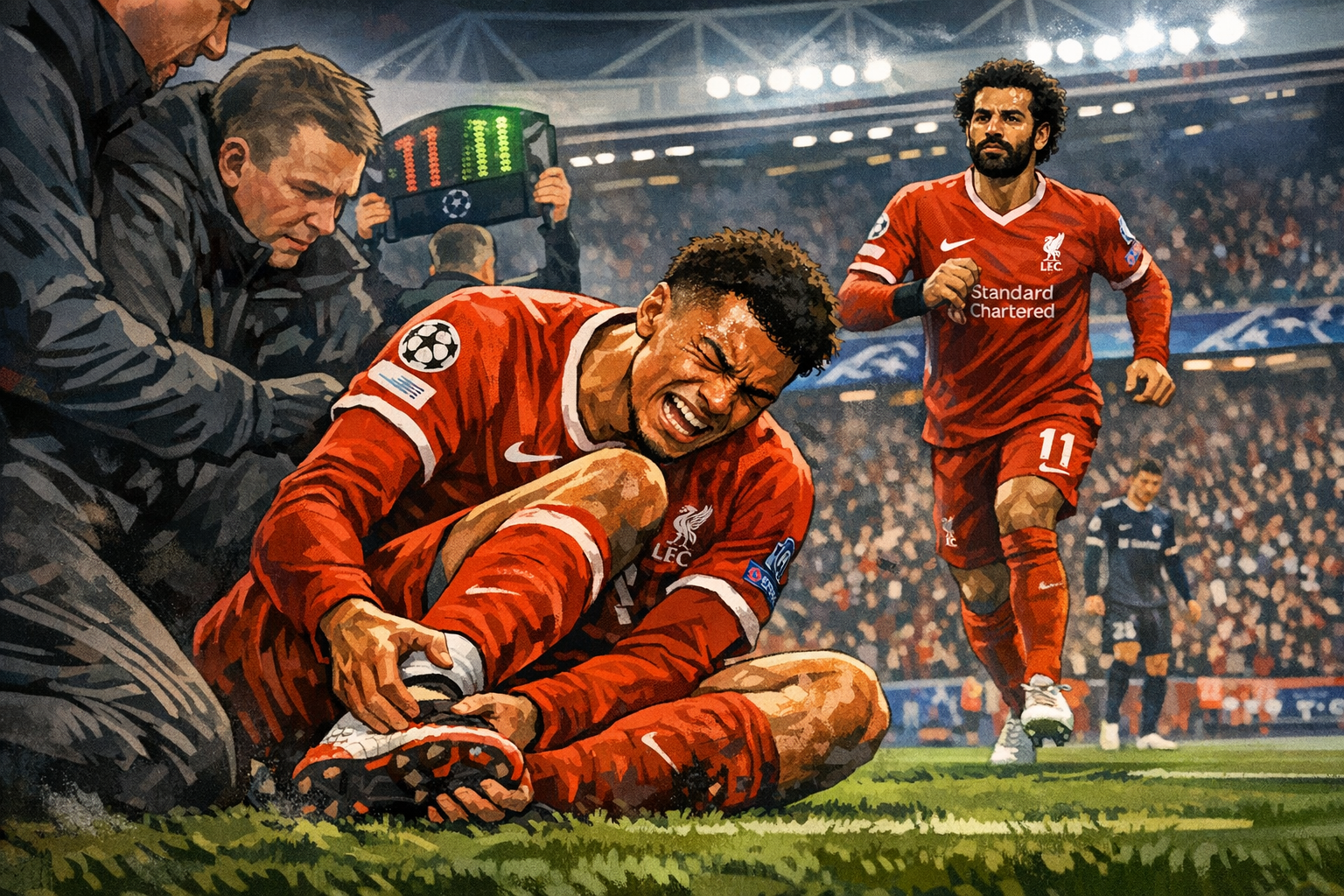
Hugo Ekitike left the field clutching his heel after barely half an hour of Liverpool's Champions League quarter-final second leg against Paris Saint-Germain — an abrupt end to his evening that may carry consequences far beyond a single fixture. The 22-year-old forward, who had been one of the most productive attacking forces in European football this season with 23 goals in 44 appearances, went down without contact after attempting to accelerate onto a through ball. The manner of the injury — a single step, a slight slip, and an immediate collapse — suggests a soft tissue problem of significant severity.
What the Mechanism Tells Us
Non-contact lower limb injuries sustained during explosive acceleration are among the most concerning in elite football, precisely because of the forces involved. When a forward plants a foot to sprint, the Achilles tendon and surrounding structures absorb multiples of the body's full weight in a fraction of a second. A slip at that precise moment — before the kinetic energy can be distributed through the stride — concentrates enormous stress on the heel and the posterior chain.
Ekitike's visible distress, the immediate clutching of his heel, and the repeated shaking of his head while receiving treatment are consistent with a significant disruption to that area, though any formal diagnosis will require imaging. Achilles tendon ruptures and severe strains both present this way at the moment of injury; distinguishing between them requires clinical examination and, typically, an MRI. The former carries a recovery timeline measured in months — often six to nine at minimum for a full return to competitive action — while the latter varies considerably depending on the degree of tissue damage.
France's World Cup campaign, scheduled for the summer, now hangs in genuine uncertainty for Ekitike. The timeline is unforgiving. Even an optimistic recovery from a serious heel injury would leave little margin for the preparation and match sharpness required at international level.
Mohamed Salah Enters at a Defining Moment
The man who replaced Ekitike carries the weight of an entirely different kind of narrative. Mohamed Salah, who has confirmed he will leave Liverpool when his contract expires at the end of this season, entered the fixture with Liverpool facing a two-goal deficit from the first leg — a position that makes progression deeply improbable by any historical measure of European competition.
Salah's relationship with the club has been visibly strained. Before Christmas, he publicly expressed frustration at reduced involvement under manager Arne Slot, criticising both the club's hierarchy and the coaching staff — a rupture that led to a single-fixture suspension. The situation has since settled into something closer to a functional truce, but the underlying tension has never fully dissipated. His numbers this season — 11 goals and nine assists across all competitions — sit well below the output that defined his previous campaign, when Liverpool claimed the domestic title.
Yet Salah's career has repeatedly demonstrated an ability to produce in high-pressure moments regardless of surrounding circumstances. If Liverpool were to overturn the deficit, his contribution to that effort would be the last major chapter of one of the most significant individual careers in the club's recent history. If they do not, his Champions League story ends here — not with a farewell designed by the calendar, but with a quiet substitution in the 30th minute of someone else's injury.
The Human Dimension That Rarely Gets Examined
One detail from the moment of Ekitike's injury deserves attention that the scoreline tends to crowd out. As medical staff arrived, Achraf Hakimi and Willian Pacho — both PSG defenders — moved toward the stricken forward and held his hands while he received treatment. It was unrehearsed and unremarkable to those on the field, but it illustrated something worth naming: the shared understanding among elite performers of what a non-contact injury means, and the particular dread it carries.
Non-contact injuries of this nature arrive without warning and without a clear causal event to point to. There is no foul to process, no moment to replay and recontextualise. The body simply fails at the instant it is asked to perform. That psychological dimension — the sudden and arbitrary nature of it — can be as difficult to process as the physical damage itself, and it frequently shapes the character of a recovery more than the medical protocol alone.
Ekitike will face that recovery at 22, in a pivotal year for his international ambitions. The medical staff around him, and the psychologists who increasingly form part of elite rehabilitation programmes, will have a great deal of work ahead.